Here’s a question I’ve been thinking about a lot lately.
A decade ago, having a website was a clear advantage. Small businesses that put their menu, hours, and contact info online got more foot traffic. Hotels that took bookings directly attracted travelers who didn’t want to call. Then every company got a website. Suddenly, having one meant nothing. You were invisible without it, but it no longer made you special.
A few years later, social media became the edge. Brands that posted engaging content built loyal communities. Then every company got a Facebook page, a Twitter account, an Instagram feed. The advantage evaporated. Today, posting a meme or a product photo is table stakes.
Now we’re watching the same pattern unfold with AI. Companies are racing to adopt ChatGPT, Claude, Copilot, and dozens of other tools. Startups are building entire businesses around AI agents. Big corporations are spinning up internal AI teams. It feels like a frantic scramble to get ahead.
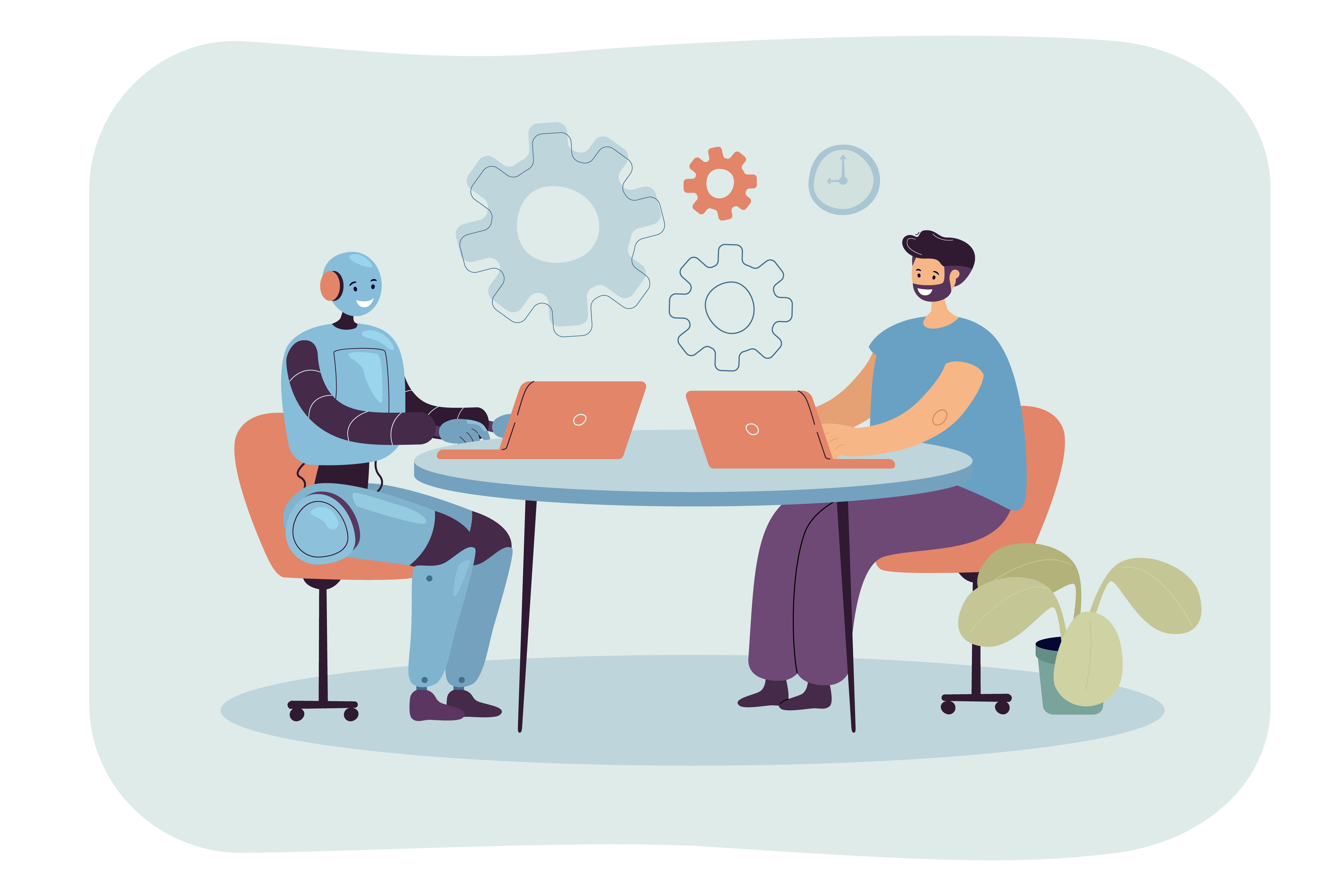
But think about where this is heading. What happens when every company, regardless of size, suddenly gains access to a capable digital worker? A worker that can draft emails, answer customer questions, write code, analyze data, create marketing copy, plan projects, research competitors, and handle endless operational tasks.
The AI itself is not the edge. It’s the new website. It’s the new social media account. And the real transformation won’t come from the technology. It will come from how organizations redesign themselves around it.
Let’s walk through what that actually looks like.
The First Wave: Productivity Explosion
Right now, we’re in the early honeymoon phase. Companies are plugging AI into their workflows and immediately seeing results.
A three-person marketing team can now produce the same volume of content as a team of ten. A solo founder can handle customer support emails, draft proposals, and write code for a prototype without hiring anyone. A small accounting firm can let an AI ingest hundreds of invoices and flag anomalies in minutes instead of hours.
The numbers back this up. A 2023 study from MIT found that consultants using AI completed 12.2% more tasks on average and finished them 25.1% faster. In customer support, companies report 30% to 50% faster response times after deploying AI chatbots. GitHub claims Copilot helps developers code 55% faster on repetitive tasks.
That’s an incredible productivity boost for any organization. But here’s the uncomfortable truth: if everyone gets that same boost, productivity alone stops being an advantage.
Imagine every competing restaurant suddenly gets AI to draft menu descriptions, optimize delivery routes, and manage inventory. The restaurant that was already running a tight ship will see the biggest gains. The one with sloppy processes will just get faster at making mistakes.
The real question isn’t “Can AI help us do more?” It’s “Are we structured well enough for AI to actually help us?”
When Everyone Has AI, Nobody Has AI
This phenomenon has a name in economics: the paradox of adoption. When a technology is rare, it provides a competitive moat. When it becomes infrastructure, the moat disappears.
Look at cloud computing. In 2010, running your servers on AWS gave you flexibility and scalability that on-premise data centers couldn’t match. Today, nearly every startup uses cloud infrastructure. It’s not a differentiator. It’s just the way you operate.
Same with smartphones. In 2007, a business having a mobile app was a novelty. Today, if you don’t have one, customers assume you don’t exist.
AI is heading down that exact path. Within five years, maybe less, every company will have some form of AI employee. They’ll use it for internal operations, customer interactions, decision support, and routine work. The question won’t be “Do you use AI?” It will be “How do you use AI in a way that actually creates value?”
And the answer to that question has very little to do with the AI model you pick. It has everything to do with your systems.
The New Competitive Moat: Systems
Let me give you two imaginary companies.
Company A has messy processes. Their sales team uses a shared spreadsheet that nobody updates. Customer data lives in three different tools that don’t talk to each other. Internal documentation is scattered across old emails and a half-empty wiki. When they try to use an AI assistant, the AI can’t find the right information. It gives wrong answers. Employees get frustrated and stop using it.
Company B has clean systems. They maintain a centralized knowledge base updated weekly. Their customer relationship management tool is integrated with their support platform. They have defined workflows for onboarding, billing, and escalation. When they plug in the same AI assistant, it accesses accurate data immediately. It drafts replies that are correct. It suggests next steps that align with their actual processes.
Same AI. Radically different outcomes.
This is what I mean when I say AI amplifies existing systems. If your company already runs like a well oiled machine, AI makes it run faster and smarter. If your company is a chaotic mess, AI just makes the mess more efficient.
I’ve seen this happen already. A friend runs a mid sized e commerce brand. They implemented an AI chatbot for customer support. Within a month, their response time dropped from 12 hours to 2 minutes. But here’s the catch: they had spent two years building a detailed FAQ and product database. The chatbot had clean data to work with. Another startup I know tried the same chatbot but had no documentation. The bot told customers the wrong return policy. They had to shut it down after a week.
The competitive moat isn’t the AI. It’s the documentation, the process design, the knowledge management, and the operational discipline that lets AI actually function properly.
AI May Expose Organizational Weaknesses
This is the part people don’t talk about enough.
Many companies assume AI will solve their inefficiencies. They believe that giving ChatGPT to their team will magically make them faster and more organized. Instead, AI often reveals how broken things really are.
Think about it. If you ask an AI to summarize your customer feedback but your data is scattered across five platforms, the AI will produce incomplete reports. If you ask it to automate your hiring pipeline but your interview process is undefined, the AI will just automate confusion. If you ask it to draft sales emails but your team has no standard templates, the AI will write in a hundred different voices.
I call this operational debt. Just like technical debt accumulates when you cut corners in code, operational debt builds up when you skip process design, ignore documentation, or tolerate inconsistent data. AI doesn’t pay down that debt. It shines a spotlight on it.
In my experience, the smartest companies are using AI adoption as a forcing function. They’re saying, “Before we deploy an AI assistant, let’s clean up our knowledge base.” Or “Let’s map out our customer journey so the AI can follow it properly.” The AI becomes the reason to fix the system, not a substitute for it.
This leads directly to a shift in how we think about hiring and team structure.
How Hiring Could Change
For years, the standard question was: “How many employees do we need to get this job done?”
You estimated workload, factored in vacation and sick days, added a margin for error, and hired a headcount. AI is going to rewrite that equation.
Organizations will start asking a different question: “What combination of people, software, automation, and AI do we need?”
Instead of hiring five junior analysts to churn through spreadsheets, you might hire one senior analyst who supervises an AI agent that does the heavy lifting. Instead of a ten person customer support team, you could have two experienced reps who handle the tricky cases while an AI handles the 80% of routine questions.
This doesn’t mean mass unemployment. It means smaller, more specialized teams. Roles will shift toward oversight, judgment, and creativity. The people who thrive will be those who can direct the AI, correct its mistakes, and handle the complex situations that require human empathy and context.
I’m already seeing this in startups. A friend’s B2B SaaS company employs 12 people today. Two years ago, they had 25. They didn’t fire anyone. They just stopped hiring when people left and let AI fill the gaps. Their revenue has grown 40% in that period.
The leaner teams move faster. They experiment more. They aren’t weighed down by coordination overhead.
The Rise of AI-Native Companies
We’re also starting to see a new breed of business: the AI native company.
These are organizations built from day one with the assumption that AI is always available. They don’t retrofit AI into old processes. They design their workflows around it.
An AI native company might have:
- A founder who uses AI to generate initial product specs and market research
- A single marketer who manages an AI driven content engine
- A customer success person who supervises an AI chatbot
- A developer who codes with AI pair programming tools
- No administrative assistants because scheduling, email triage, and note taking are automated
These companies operate with 5 to 10 people doing what used to require 30 or 40. They can iterate faster because the cost of experimentation is lower. They can scale operations more easily because AI handles the workload spikes.
Compare that to an established enterprise trying to roll out an AI assistant to 5,000 employees. They have legacy systems, entrenched processes, and cultural resistance. The AI native company doesn’t have to unlearn anything. It just builds smarter.
This doesn’t mean the incumbent giants die overnight. But it does mean the bar for starting a competitive business keeps dropping. A solo founder with the right systems can now compete with teams of 50. That changes markets in ways we haven’t fully grasped.
A World Where Intelligence Becomes Abundant
Zooming out, the bigger implication is about the nature of expertise.
For most of history, access to knowledge was scarce. If you needed a legal contract drafted, you hired a lawyer. If you needed financial analysis, you hired an accountant. If you needed market research, you hired a consultant. Expertise was expensive and slow.
Now, AI can produce passable first drafts of legal documents, financial models, and market analyses in seconds. Not perfect. Not always accurate. But good enough for many purposes.
So what happens when expertise becomes cheap?
Some skills will become less valuable. Routine knowledge work that follows clear patterns will be increasingly handled by AI. But other skills will become more valuable. Things like:
- Judgment: Knowing when to trust the AI and when to override it.
- Leadership: Motivating people, resolving conflicts, building culture.
- Creativity: Generating novel ideas that go beyond pattern matching.
- Context: Understanding the specific nuances of a customer, a market, or a situation.
- Trust: Building relationships that make people feel safe and understood.
These are the things machines still struggle with. And they’re the areas where human employees will focus more of their energy.
The irony is that AI may actually make human skills more valuable, not less. Because when intelligence becomes abundant, the scarce resource becomes wisdom, empathy, and the ability to make good decisions in messy, ambiguous situations.
So What Actually Separates the Winners?
Let’s go back to the original question. If every company gets the same AI employee, what separates the winners from everyone else?
I think it comes down to three things.
First, systems design. The companies that invest in clean processes, good documentation, and integrated tools will get ten times more value from AI than those that don’t.
Second, human judgment. The teams that use AI as a tool for amplification, not a crutch for poor decisions, will produce better outcomes. They’ll know when to edit, when to question, and when to throw out the output entirely.
Third, organizational agility. The businesses that treat AI as a reason to rethink how they work, not just a faster way to do the same things, will adapt faster. They’ll restructure teams, rewrite workflows, and redesign roles. The ones that try to bolt AI onto old systems will fall behind.
The future isn’t defined by which companies have the most AI. It’s defined by which companies redesign themselves around it.
Just like the internet stopped being a differentiator and became infrastructure, AI will follow the same path. The winners won’t be the businesses with the most advanced AI models. They’ll be the ones with the best systems, the sharpest judgment, and the courage to change how they operate.
And that’s a future worth thinking about now, before every company already has an AI employee and the real race begins.